Showing posts with label 18th century. Show all posts

Tuesday, July 5, 2011

Independence Day Fun


More fun from the National Archives and the Don't Know Much blog.

-Jefferson is the principle author of the Declaration of Independence with assistance from Franklin and Adams. The latter's edits were incorporated into the final version.

-The D of I was actually passed on July 2nd. Whoops.

-The D of I was signed over the course of a month. The famous painting of each signer coming up to the desk is not true.

-Hancock's signature is not so large because he wanted the king to be able to read it without his glasses. It's because he was the first to sign.

-With the exception of Hancock, everyone's signature is placed geographically to the state he represented.

-The D of I has traveled around quite a bit. Most interestingly to an unused gristmill in Virginia during the War of 1812.

-Reese Witherspoon is a direct descendent of declaration signer John Witherspoon.

Sunday, April 17, 2011

Check Your Books


One of my new favorite shows is History Detectives. Even though the show has been on for 8 seasons, I've just discovered it. Here's a great story from one of the episodes.

John Adams loved books. He had a huge library which has been distributed to various libraries, historical societies, and museums since his death. Interestingly, Adams had two literary habits: signing and dating his book and annotating in the margins.

He also apparently loved sharing. Many of Adams' books have made their way into the hands of the public. He would give books as gifts (complete with signature and annotations). These books have therefore not made their way to an Adams library or museum. I'm sure many people realized they had something more than a keepsake when Adams rose to the Presidency in 1796. So, check your personal libraries; especially if you live in New England. There may be an old book in your attic that's not only signed by our second President but is complete with his feelings on the text.

Tuesday, April 5, 2011

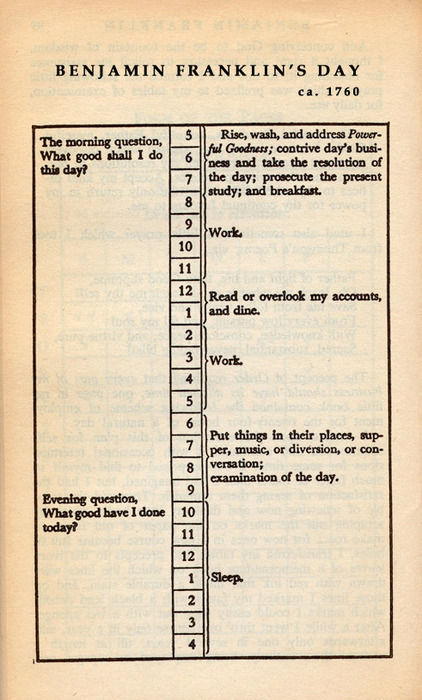
Ben Franklin's Daily Schedule


From the patron saint's autobiography...

The morning question,
What good shall I do this day?

5:00 AM-8:00 AM
Rise, wash, and address Powerful Goodness; contrive day's business and take the resolution of the day; prosecute the present study; and breakfast

8:00 AM-12:00 PM
Work.

12:00 PM-2:00 PM
Read or overlook my accounts, and dine.

2:00 PM-6:00 PM
Work.

6:00 PM-10:00 PM
Put things in their places, supper, music, or diversion, or conversation; examination of the day

Evening question,
What good have I done today?

10:00 PM-5:00 AM
Sleep.

Sunday, March 13, 2011

Capitol over Dinner


Why is Washington D.C. our nation's capitol? In Federalist #43, James Madison said we needed a capitol that was separate from a state in response to an attack on the Philadelphia location of Congress in 1783. Remember Madison. He'll come up again.

Fast forward to 1790. A dejected Alexander Hamilton just left a meeting with George Washington. Outside Washington's quarters, he met up with rival Thomas Jefferson. Hamilton explained that Washington didn't think there was enough support for Hamilton's plan of assumption (a plan where all of the nation's debt would be taken on by the federal government). So the story goes, Jefferson invited Hamilton and the main critic of assumption, James Madison, to his house for dinner. The three sat down and hammered out an agreement. Madison would not vote for assumption but would not criticize it so fervently. In exchange, the capitol would move to a location on the Potomac River.

Here's Jefferson's account:
They came. I opened the subject to them, acknowledged that my situation had not permitted me to understand it sufficiently, but encouraged them to consider the thing together. They did so. It ended in Mr. Madison’s acquiescence in a proposition that the question should be again brought before the House by way of amendment from the Senate, that tho’ he would not vote for it, nor entirely withdraw his opposition, yet he should not be strenuous, but leave it to its fate.

Hamilton got his financial plan and ten years later the capitol moved from Philadelphia to Washington D.C.

For more info: This and "the duel" post came from my favorite book; Founding Brothers by Joseph Ellis. I picked it up for a third time this week after being asked what my favorite book was by our school librarian. As a fun side note, I first read the book as a history undergrad. I wanted to study early America with Ellis. I looked him up and found he was a professor at Mt. Holyoke. I'm glad I realized Mt. Holyoke is an all girls school before I mentioned it to anyone.

Monday, January 17, 2011

Beer or wine, Ben?


Benjamin Franklin has many famous quotes. One of his most famous may actually be a misquote. The patron saint of PA is often depicted as saying, "beer is proof that God loves us and wants us to be happy." The truth is that this quote was mostly fabricated by beer makers in order to sell more beer.

What Franklin actually said in a letter to Andre Morellet in 1779 is:
"Behold the rain which descends from heaven upon our vineyards, there it enters the roots of the vines, to be changed into wine, a constant proof that God loves us, and loves to see us happy."

In any event, history tells us that ole' Ben enjoyed his share of both wine and beer.

Thursday, January 13, 2011

Washington's Whiskey


After eight years as President, George Washington returned to farming at his Mount Vernon estate. Someone mentioned that he might make a bit more money if he used his extra corn to make whiskey. Washington decided to give it a try. In 1798, he sold 4,000 gallons at 50 cents per gallon. In 1799, he sold 11,000 gallons.

These results are a little surprising as Washington's whiskey wasn't very good. Washington's problem was that he concocted, barreled, and sold. Historian Peter Carlson said that rushing the process flavored Washington's product with "notes of kerosene and turpentine." He continued that drinking it, "burned the throat, wrung tears from the eyes, and produced a hangover that made a drinker feel like he'd been beaten by an angry mob."

Maybe people drank it because it was the President's whiskey after all? Nope. Washington packed it in huge barrels and sent it to distributors. Customers didn't know or really care where their whiskey came from. Pretty much all the whiskey of the late 18th century was equally as bad.

Later distillers such as Jim Beam and Jack Daniels realized that placing your whiskey in burned out oak barrels and allowing it to age would create a better flavor. Jim Beam bourbon will age for about ten years. Jack Daniels scotch is filtered through charcoal and then aged in the burned out barrel for about the same amount of time. Washington's hooch aged for about 10 minutes.

For more info, I suggest:
Peter Carlson's article "Revolutionary Spirits" appeared in my favorite magazine American History.